
Author: admin

Mount Juliet Taekwondo

In 1980, 20-year old Kenneth Page was living in a suburb of Nashville, TN, wanted to engage in a physical exercise program, and participate in some self-defense training. He found a Taekwondo school, liked the discipline, and earned some awards. He was hooked.

After working for Marathon Petroleum Corporation for 19 years, he was looking for something

to do on the side or find another job. While working with an Inner City Nashville Mission Church, he was led to a little two-room schoolhouse where he initially opened his Taekwondo facility two days a week with 19 students. But his unique approach of teaching biblical life lessons and values of respect, hard work, and focus through the discipline of Taekwondo gained more students. Soon there was a small After School Program and a summer camp.

In 2009, he moved to Mt Juliet, on the east side of Nashville, and purchased a 12,000 sq. ft. building which became the home of Mount Juliet Taekwondo. The business began to grow and attract students until now there are almost 200 students who come daily to the facility. While many of the students of Mount Juliet Taekwondo have won local and regional meets and competitions and qualified for National Championships, Page says they learn more than physical skills. “The students develop self-discipline through Taekwondo and a godly spirit by growing spiritually from within. We train the kids to work for goals and how to handle losses with grace and wins with humility.”

However, the After School Program is probably the heart of Mount Juliet Taekwondo. In fact, 65% of the enrolled students participate in the After School Program. Ten vans and two buses pick up kids after school and drive them to the facility for a snack and a drink. The students change into uniforms, do homework, report on their grades and receive help with schoolwork. Afterwards, they receive Taekwondo training through one of four classes and engage in some outside physical activity. When the After School Program is over, each child is walked to their parent’s car. It is all about the children.

Auris Payroll Solutions, through Extra Credit, provides the contributions to the After School Program from the payroll processing fees paid by Mt Juliet Taekwondo. Page says, “The contributions have helped pay the expenses of the After School Program. We have used the contributions to pay for uniforms, drinks, and t-shirts for students attending summer camp who need help paying the fees.” Auris and Extra Credit are proud to help Page with his ministry to children through contributions to the Mount Juliet Taekwondo After School Program.
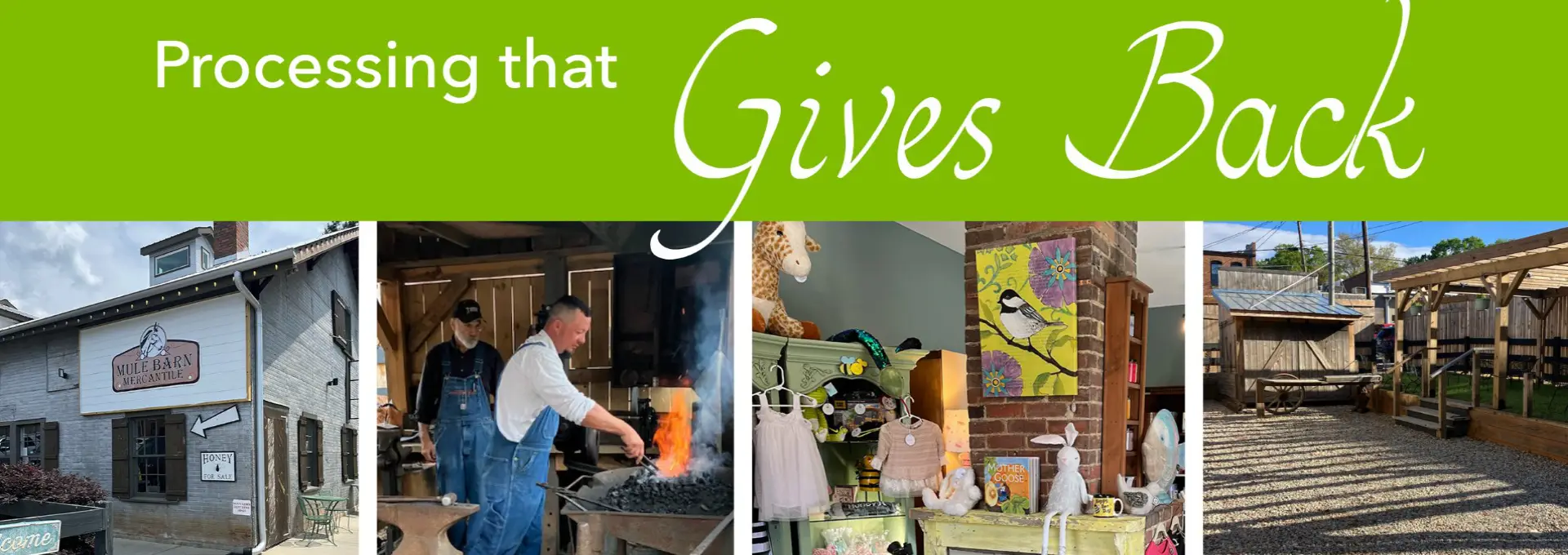
 

Processing that gives back - Union County Entrepreneurs

Union County Entrepreneurs Testimonial

While others may have seen an 83-year-old boarded up and forgotten livery stable in Waxhaw, North Carolina, located about 22 miles southeast of Charlotte on NC-16, Mark Hernig saw a piece of history that ought to be saved and brought back to life. After purchasing the building in 2015, Hernig renovated the old Mule Barn and asked the Union County Entrepreneurs (UCE) to help develop a use for the structure.

Upon trying a number of different ideas for the building over the next several years, UCE, its board members and Karen Johnson, Director of Union County Entrepreneurs Business Incubator, created the Mule Barn Mercantile to benefit the community, be a part of the restoration of the historic downtown area, and provide a way for fledgling business owners to begin their startup businesses. UCE developed a small business incubator program focusing on retail entrepreneurship, a youth training program, and a mentorship program for those striving to franchise and build service businesses. Today, 87 local entrepreneurs are able to develop their own brands, sell and share a coveted location in the Mule Barn of downtown Waxhaw.

Loyd Pennington, long time Waxhaw business owner and former president of the Waxhaw Business Association, said, “Entrepreneurship is the key to this country and the Mule Barn Mercantile provides opportunities to build an enterprise around the dreams of local small business owners where nothing else exists.”
Johnson and UCE Board Members screen the entrepreneurs to ensure they are unique to Waxhaw and want to learn successful business practices of owning their own business. Johnson said, “The entrepreneurs are not just renting space, but must follow the Barn’s established business model which aims to keep the Barn’s merchandise fresh while meeting the needs of the consumer base in Waxhaw. The desire is not to be in competition with other businesses in town, but to walk alongside newer businesses that add to the town’s appeal. Also, if an entrepreneur has a goal of moving into their own brick and mortar location, the UCE has resources to help them grow in that direction.”

Wilhelmina (Wil) Dees is one who used the resources of UCE and advice of Johnson when she left a secure corporate job to open a small business selling Alpha-Stim, a prescriptive medical device. She said, “Karen really spent time to help me grow my business. She taught me to be resilient, to keep going no matter what, and to always look for new opportunities.”

The donations from Extra Credit have been an important part of the financial growth of UCE. Pennington remembers, “In the early days, the funds from Extra Credit were used to promote the space, create the signage, and help pay for the utilities. Those funds were vital.”

Johnson commented on the monthly payment from Extra Credit, “The contribution from Extra Credit may seem small to some, but the monthly amount is a huge blessing to us! Because we are a very small business incubator trying to keep our focus on the needs of entrepreneurs, we are using the contributions to make our new concept a reality to help people with small businesses.”

choralis

Choralis Testimonial

In August, 2000, Artistic Director Gretchen Kuhrmann founded Choralis, a choral music ensemble devoted to excellent choral performances, professional development opportunities for young soloists and conductors, and education and training for high school students. Today, Choralis, an auditioned SATB chorus, has become one of the finest choral organizations in Northern Virginia and in the Washington DC area.

Audiences throughout the United States and Europe and critics alike have recognized Choralis for its musical excellence. Critics observed “…Kuhrmann has trained this big group to sing with the delicacy and transparency of a chamber chorus, and it does this very well.” (Washington Post)

But providing wonderful choral opportunities is not the only thing in which Choralis excels. Kuhrmann explains, “Choralis is committed to partnering with local and national charities at each concert, highlighting critical needs and giving opportunities for our patrons to learn about ways to help.” Further, “Choralis collaborates with other arts organizations to reach underserved and diverse populations, sharing the joy of music with all.”

Only about 25 percent of Choralis revenue comes from ticket sales. As a result, grants, donations, and funds from Extra Credit are essential to continue providing large-scale choral works with orchestras to audiences. Through participation in the Extra Credit Donation Program through Heartland Payment Systems, multiple business owners have designated Choralis as the recipient of monthly contributions from the card processing fees they pay to Heartland. Choralis Foundation Board Chair Barbara Alexander comments, “Extra Credit contributions have been a critical component of our budget…Like many organizations, the pandemic was a challenge as we did not sing for over two years. But with generous contributions, including those from Extra Credit, we not only kept our organization running, but were able to pivot to innovative ways of keeping our singers engaged and supported…Coming back from the pandemic, these contributions have helped us keep going while we grow our donor base and return to full-scale performances.”

Based upon support from Extra Credit, Heartland Payment Systems, other organizations, and individuals, the future looks bright for Choralis. Kuhrmann says, “The arts matter! Choralis will continue to be a beacon for those musicians and patrons who wish to experience great musical art at the highest level.” Others think so as well. Jeff, a tenor, says, “I’ve been involved with Choralis off and on for more than a decade. I’m not a professional singer, but I sing in my church choir, and what I’ve loved about Choralis is that it kicks things up a notch…It’s a tremendous and supportive community.” High school singer Lucy, who plans to major in piano and classics after graduation says, “I’ve loved that Choralis allows me to be a part of the community in a way that I don’t have in my high school… (T)his allows me to sing with people of all ages and walks of life and in the community and that is great.” Finally, Susan, who has sung with Choralis about 8 years said, “I’m a classically trained musician and I wanted to do more serious literature than we can do with my church choir. We can do larger works and perform with a larger group and orchestra. I love the variety of music we do, especially the masterworks, but I also love that we do works by new composers and bring really meaningful works to our audience….It’s not just notes and rhythm, it’s MUSIC, with a message and emotions.”

Hunger 2 Hope Testimonial

Gina Colville, Office Manager of Eyear Optical, an optometrist center in Southaven, Mississippi, said that Dr. John Carlson OD, asked her to find a nonprofit organization that his practice could support through the Extra Credit Donation Program. She said, “Through Dr. Carlson, we give back to the community. We support many organizations and help financially a family at Christmas. We looked for a local charitable organization that helped kids to which we could provide regular financial support. We found Hunger2Hope and have been so pleased to financially partner with them.” From the processing fees paid by Eyear Optical to Heartland Payment Systems, Extra Credit and Heartland Payment Systems make a financial contribution on behalf of Eyear Optical to Hunger2Hope each month.

Continue reading

Salvation Army

“For over 131 years, The Salvation Army has been preaching the Gospel of Jesus Christ and meeting human needs in His name without discrimination in the San Antonio and New Braunfels, Texas areas,” said Brad Mayhar, Public Relations/Media Manager for The Salvation Army – San Antonio Metropolitan Area Command. The Salvation Army is a nonprofit organization to which Extra Credit sends monthly donation checks from credit card processing fees paid by Mattresses and Furniture for Less to Heartland Payment Systems.

Continue reading

Memphis Dream Center

Fabian Nelson, owner of the Potbelly Sandwich Shop in Olive Branch, MS since 2018, had been the successful national director of sales for a medical device company for a number of years. While business was going well, something other than money, prestige, and power was calling him. “I was looking for an opportunity to develop a family-run business where I could highlight my love of food with my neighbors and make an impact in the community where I live,” said Nelson.

Continue reading

Giving Hope New Orleans

“New Orleans based Giving Hope is a nonprofit organization that mirrors the passions of founders Troy and Tracy Duhon,” said Ben Comer, Executive Director of the Giving Hope Foundation. The idea for Giving Hope was birthed after the devastation caused by Hurricane Katrina in 2005, when the Duhons and Comer worked together in their church outreach to set up afeeding center for New Orleans residents at Duhons’ Premier Honda dealership. The Duhons saw how important food distribution was to the homeless and needy, so they were moved to acquire and operate a food pantry funded in part through donations, a program of giving $25 from the sale of each new and used car from the Duhons’ dealerships, and contributions from the Extra Credit Donation Program as well as from other companies and individual donors.

Continue reading

Are You Ready for Charitable Gift Planning

Two experts recently listed ten considerations for development directors to ask of their nonprofit organization before embarking on a charitable gift planning program. Through a webinar to members of the Memphis, TN chapter of the Association of Fund Raising Professionals, Brian Sagrestano, JD, CFRE and Robert Wahlers, MS, CFRE encouraged the directors to determine whether:

  1. Their nonprofit had a mission statement.
  2. The mission would still be relevant in 50-100 years.
  3. There was a compelling need for charitable support to sustain the mission.
  4. Their nonprofit had an effective strategy in place to implement the mission.
  5. The staff and Board leadership are interested in pursuing long-term support.
  6. The nonprofit is financially stable.
  7. The development staff pursues endowments to ensure the long term future of the nonprofit.
  1. Individuals regularly give support to the nonprofit through campaigns and programs.
  2. There is a group of loyal donors who have supported the nonprofit in the recent past.
  3. The development staff can set aside one hour per week for the next year to invest in gift planning.

If you answered, “yes” to all ten items and want to develop a gift planning program, you may contact Brian at brian@giftplanningdevelopment.com or Robert at rwahlers@meridianhealth.com for more information.

Brian Sagrestano short

Brian Sagrestano, JD, CFRE is an author, public speaker, and thought leader in the gift planning world. After many years running gift planning programs for nonprofits, he formed his consulting firm, Gift Planning Development. Brian is also a principal in Constellation Advancement, a full-service development consulting firm.

RobeRobert Wahlersrt Wahlers, MS, CFRE serves as the Vice President of Development for Meridian Health Affiliated Foundations where he leads the gift planning program and oversees the annual giving, grants, and foundation teams. Robert also serves as an Adjunct Professor at Columbia University for the Masters in Nonprofit Management Program.

10 Steps to Becoming a Successful Development Director

Terri Lee Freeman, president of the National Civil Rights Museum in Memphis, Tenn., recently spoke to development directors of numerous nonprofit organizations about key attributes of successful fund-raising activities. In particular, Ms. Freeman counseled the development directors to:

1. Be a developer of relationships.

Treat every donor as special, rather than just as a fundraiser. You turn a one-time donor into a regular donor by spending time and attention on the donor.

2. Like everyone with whom you talk.

In addition, be a good listener.

3. Show the donor the benefit derived from his or her gift.

Help them realize the value of their gift not only to the nonprofit, but also to them. Answer for them the sometimes unasked question, “What is in it for me, the donor?”

4. Demonstrate your expertise.

Know what goes on in your organization and be able to connect the donor with the important or right people to answer his or her question or concern.

5. Be fearless and persistent.

Ms. Freeman explained that most development directors ask for a donation too soon in the development of their relationship with a donor and, as a result, ask for too little from the donor. Build a good relationship with a donor before you present a request for a donation. “Remember,” she said, “People give to people, not to organizations.”

6. Do your research about the donor.

Find out what projects a donor usually funds, what amounts a potential donor has given, and to what organizations has the donor previously provided donations. She said, “Importantly, always spell their names correctly. If I receive a request for a donation that is addressed to my misspelled name, I will not even consider it.”

7. Communicate, communicate, communicate!

Don’t just send a form thank you letter for the gift and a newsletter and one year later ask the donor for another donation. Communicate with the donor before you ask for a donation, during the period when the donor is considering your request, and after the request has been approved or denied. Find out why your request was approved or denied, as this information will help you with future donors. Communicate by telephone, email, invitations to events, and lunch invitations. Keep the donor apprized of what is going on with your organization.

8. Highlight the goals of your organization.

While statistical data is important, individual stories are more important. When the donor visits your office, have someone benefiting from the services of your organization speak with the prospective donor. In presentations to donors, add pictures and charts.

9. Sustain the relationship with individual donors.

She explained, “We all have a lack of time, energy, and money, but we must make time to communicate with our donors to sustain the relationship of the donor with you and the organization. As the relationship is growing, ask them to help you find other donors for your organization.”

10. Encourage your CEO to continue to develop relationships with current and potential donors.

It is important for them to continue to build the program of the nonprofit. Work hand in hand with the CEO to develop the mission of the nonprofit.


Terri Lee Freeman was appointed president of the National Civil Rights Museum in November 2014. As president, Ms. Freeman is responsible for providing strategic leadership in furthering the museum’s mission as an educational and cultural institution. Ms. Freeman’s goals for the museum include establishing the museum as the new “public square” for dialogue about and around civil and human rights, providing a safe space for people to exchange and learn; becoming an institutional center for the promotion of nonviolence, social justice and equity; and being a “hands on” educational resource for those desiring historical knowledge of civil and human rights. Prior to leading the National Civil Rights Museum, Ms. Freeman served as president of the Community Foundation for the National Capital Region in Washington, D.C. Ms. Freeman was identified by the Washingtonian Magazine as one of the 100 Most Powerful Women of Washington.